When the Economy Improves but Households Still Struggle
Nigeria’s macroeconomic indicators are improving. Household budgets have not yet caught up.
Nigeria’s economy is showing signs of stabilisation, including lower inflation and projected higher real GDP growth, but many households continue to face financial pressure because prices remain high and purchasing power has not recovered. The key challenge is to translate macroeconomic improvements into tangible gains in household welfare through stronger real incomes, more affordable food and transportation, productive employment, and greater economic opportunities. Ultimately, economic progress will be most meaningful when improvements in macroeconomic indicators are reflected in the daily lives of ordinary Nigerians.
There is an important distinction in Nigeria’s economic story: macroeconomic conditions are improving while many households continue to face financial pressure. These two realities are not contradictory. An economy can stabilise before household purchasing power fully recovers.
The latest numbers from the National Bureau of Statistics show a meaningful improvement in the inflation picture. Headline inflation has fallen dramatically from the levels recorded in 2024 and is now around 15.4 percent. The International Monetary Fund (IMF) has also noted that inflation persistence has declined and that the economy is becoming more responsive to monetary-policy actions. These are not trivial achievements. The IMF, meanwhile, projects real GDP growth of about 4.1 percent for Nigeria in 2026. But there is another number that deserves equal attention: 15.4 percent inflation is still double-digit inflation. And headline inflation is only an average. For a Nigerian household, the relevant question is not whether the national Consumer Price Index has fallen from its peak. The question is much simpler: How much does it cost me to eat, move around, pay rent, educate my children and keep my family healthy? That is where the macroeconomic story begins to collide with the household story.
–
Falling inflation does not mean falling prices This distinction is important. If inflation falls from 25 percent to 15 percent, prices have not fallen by 10 percent; they are still increasing, only more slowly. And the price increases of previous years do not disappear because the inflation rate has moderated. This is why a government can legitimately point to declining inflation while citizens legitimately complain that life remains extraordinarily expensive.
Nigeria’s current inflation statistics make the point. The NBS’s CPI shows headline inflation at about 15.4 percent, while core inflation is lower, at about 13.3 percent. But the headline figure masks significant differences among categories of household expenditure. Food, for example, matters far more to a poor or lower-middle-income household than it does to a household whose consumption basket contains a large proportion of discretionary services. Food inflation is hovering around 20 percent.
–
From stabilisation to recovery The next question is whether macroeconomic stabilisation is translating into broader improvements in living standards. Lower inflation does not automatically restore purchasing power lost during earlier periods of rapid price increases. Exchange-rate stability does not, by itself, make food affordable. Stronger public revenues do not automatically increase household incomes. This is the difference between macroeconomic performance and household welfare.
–
A broader lesson The United States offers a useful illustration of the same economic dynamic. During 2024, economic indicators such as employment, growth and inflation were cited as evidence of improvement, yet surveys showed that many Americans remained concerned about the economy. One reason was that lower inflation did not reverse the higher level of prices that had already been established. The broader lesson is relevant beyond any one country: people experience the economy through the relationship between income and the cost of living. Macroeconomic indicators remain important, but household conditions provide another essential measure of economic progress.
–
Nigeria’s next economic challenge Nigeria has been addressing long-standing economic constraints involving fuel subsidies, foreign exchange, public finances and productivity. Reforms in these areas can involve significant adjustment costs before their benefits become broadly visible. The central economic question now is how to translate stabilisation into sustained improvements in living standards. That means looking closely at whether real wages are recovering; whether transportation costs are becoming more manageable relative to income; whether food production and distribution are becoming more efficient; whether electricity costs support productive activity; whether businesses can expand and create jobs; and whether young Nigerians can find productive work. It also means recognising the cumulative effect of several years of higher prices on household purchasing power.
–
From macroeconomic credibility to household confidence Nigeria needs both sound economic fundamentals and tangible improvements in household welfare. Macroeconomic credibility comes from effective monetary and fiscal policy, stronger institutions, higher productivity, investment and sustainable growth. Household confidence grows when people can see those improvements reflected in their daily lives. Neither dimension should be dismissed. Economic indicators show whether the broader economy is stabilising; household indicators show whether that stabilisation is becoming a recovery. Ultimately, the purpose of economic policy is not simply to improve statistics. It is to build an economy in which those improvements are visible in the lives of ordinary Nigerians. When that happens, economic progress becomes something households experience, not merely something they are told about.
–
This commentary was written exclusively for Macrostrat Nigeria Limited by Dr. Olumuyiwa Adedeji, the founder of 4MNT, a top Washington, USA-based global economic management and policy consulting firm. The article is published as part of Macrostrat's commitment to fostering informed dialogue and diverse perspectives on economic policy and national development.
–
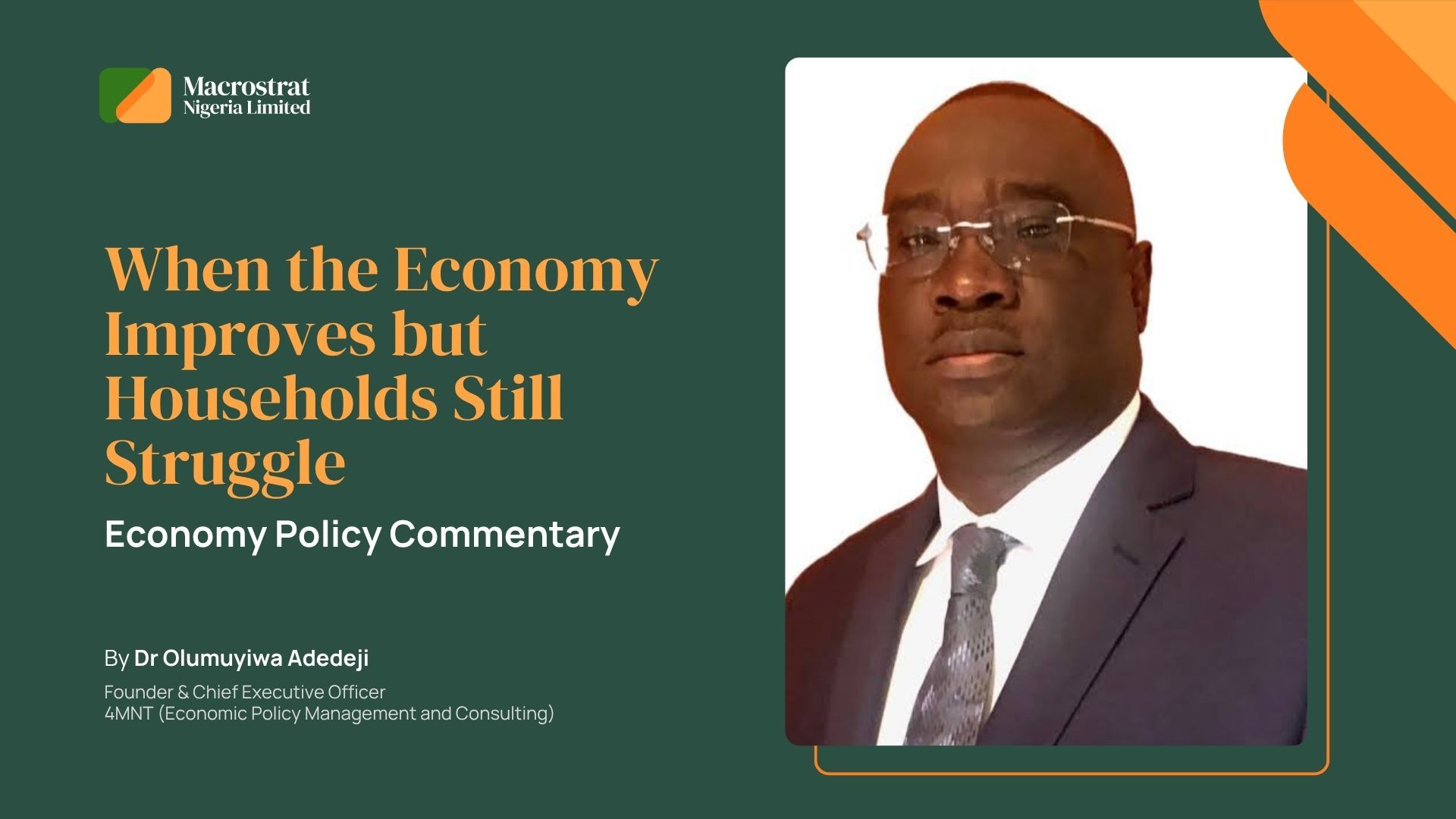
Dr Olumuyiwa Adedeji
Founder & Chief Executive Officer
4MNT (Economic Policy Management and Consulting)
Get in touch: [email protected]