Nigeria’s Rate Cut Puts Business Lending to the Test
GLOBAL ECONOMY: REVIEW (21–27 SEPTEMBER 2026)
The week was dominated by United Nations General Assembly (UNGA) diplomacy in New York and a fresh leg of the global sovereign-bond and energy-market volatility. On Wednesday, 23 September 2026, President Trump warned the UNGA that Iran faced a choice between a diplomatic deal or "annihilation" of the regime if the Middle East conflict remained unresolved, sustaining a geopolitical risk premium in oil and the US dollar. Presidents Trump and Xi met on the sidelines on Wednesday, 24 September, discussing trade, technology, industrial capacity and the Middle East and Russia-Ukraine wars, but no structural breakthrough emerged.
Brent crude swung between sub-$100 and roughly $107 per barrel on alternating Iran headlines, while the benchmark US 10-Year Treasury yield touched its highest level since July 2007, near 5.2%, on Thursday, 24 September, and the Dollar Index (DXY) rose to a near two-month high. Gold slipped toward a one-week low below $4,300/oz as the post-hike hawkish Fed repricing and UNGA-week risk premium favoured the dollar. Regional Federal Reserve presidents Musalem, Goolsbee, Collins and Barkin all signalled openness to further policy tightening following the Fed's first rate hike since 2023, extending a heavy post-blackout "Fedspeak" wave.
In corporate and market news, Microsoft unveiled a broad agentic overhaul of Copilot on Friday, 26 September, embedding Word, Excel and PowerPoint directly inside its AI interface; UPS fell about 4% on a Bank of America downgrade citing weaker package volumes, while MicroStrategy (MSTR) fell roughly 6% despite disclosing a further 950 BTC purchase (Weekly Breakdown, 2026). Across Europe, sovereign bond-market stress persisted, with French OAT spreads over Bunds remaining unusually wide relative to Italy, underscoring the core-periphery role-reversal.
–
GLOBAL ECONOMY: OUTLOOK (28 SEPTEMBER–4 OCTOBER 2026)
Markets enter the new week digesting the Trump–Xi summit outcome and the UNGA's unresolved Iran diplomacy, with tanker traffic through the Strait of Hormuz reported at up to 14 million barrels/day despite the standoff, and the East–West Saudi pipeline back in regular flow. A heavy US data slate is due, including the ISM manufacturing index, PCE inflation, personal income and spending, JOLTS, Conference Board consumer confidence, GDP revisions and the monthly employment report; in Europe, flash PMIs and CPI prints are due, and China's official PMIs will be watched even as its 1–7 October Golden Week holiday thins regional liquidity.
Continued Fedspeak is expected as officials debate the pace of further tightening after September's hike. Government-bond supply remains a swing factor: sovereign issuers in Washington and European capitals continue auctioning unprecedented volumes to fund fiscal deficits, testing the market's absorptive capacity and term premia. Energy-market watchers will track whether Saudi Aramco's curtailment of European crude deliveries and continued Houthi threats to Gulf infrastructure further deplete thin inventories, with a bearing on refined-product prices such as US retail diesel, which has traded near record highs above $6.45/gallon.
–
AFRICA: REVIEW AND OUTLOOK
The South African Reserve Bank raised its repo rate by 25 basis points to 7.25% (prime to 10.75%) on Wednesday, 23 September 2026, in a split 4–2 vote, citing the risk that elevated oil and food prices could trigger second-round inflation effects; the SARB lifted its 2026 CPI forecast to 4.4% and its Brent price assumption to $90/bbl for 2026. South African CPI itself edged up to 4.4% in September from 4.3% in July, with food inflation rising for the first time in nine months even as SARB maintained its 1.2% growth forecast (Forbes Africa, 2026). Egypt's Central Bank held its key policy rates unchanged at its Monetary Policy Committee meeting of 24 September 2026, continuing a cautious disinflation path after urban inflation eased to 14.5% in August from a three-month high of 14.9% in July. Egypt also reported diaspora remittance inflows of US$29.7 billion for the first seven months of 2026 (Central Bank of Egypt, 2026c). Elsewhere on the continent, Ghana's inflation rose for a third consecutive month on higher transport, rent and school-fee costs, while several West African sovereigns continued to tap Eurobond markets. Into the outlook week, African central banks — including the CBN — continue calibrating policy against the same imported-inflation channel: elevated global oil and freight costs set against improving currency and reserve positions across several of the continent's largest economies.
–
–
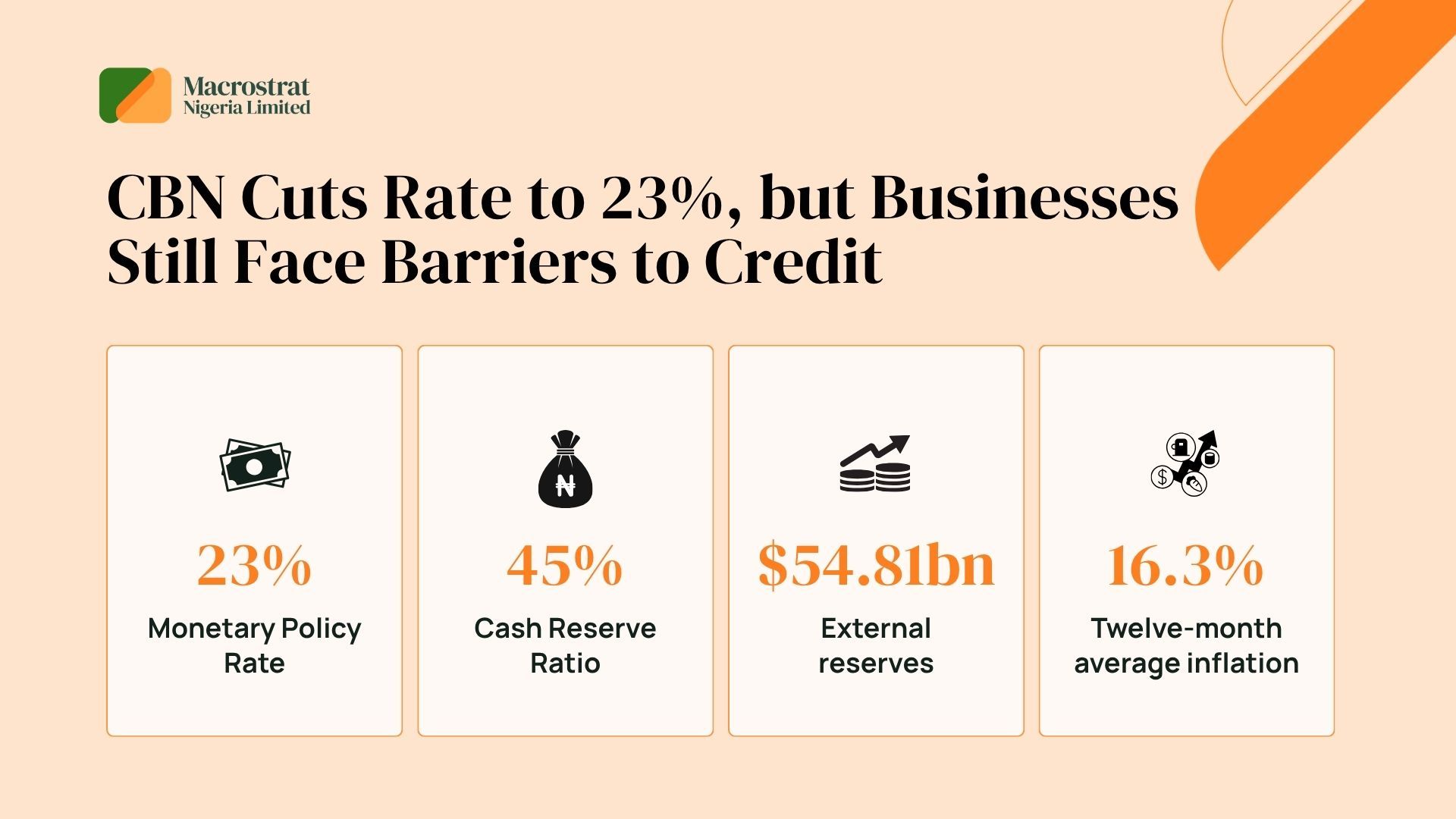
NIGERIA: REVIEW (21–27 SEPTEMBER 2026) Monetary Policy. The CBN's Monetary Policy Committee, at its 307th meeting held 21–22 September 2026, cut the Monetary Policy Rate (MPR) by 350 basis points — the largest single reduction since the MPR framework was introduced — from 26.5% to 23%, returning the rate to its February 2024 level and 4.5 percentage points below the cycle's 27.5% peak. The Committee recalibrated the Standing Facilities Corridor to +50/-300 basis points (from +50/-450bps), while retaining the Cash Reserve Ratio at 45% for Deposit Money Banks, 16% for Merchant Banks and 75% for non-TSA public-sector deposits, and the Liquidity Ratio at 30%. Governor Olayemi Cardoso described the move as an operational realignment to strengthen policy transmission rather than a change of stance. The Lagos Chamber of Commerce and Industry welcomed the cut as relief for MSME financing costs, while cautioning that non-rate factors — insecurity, collateral quality and sectoral risk — will continue to constrain actual credit flow.
Foreign Exchange, Reserves and BOP. Following the rate cut, the naira weakened marginally to ₦1,328.50/US$ at the official NAFEM/NFEM window (a 0.05% depreciation) and to about ₦1,387/US$ in the parallel market, even as gross external reserves rose further to $54.808 billion by 24 September 2026 — their highest level since December 2008. Nigeria's Q2 2026 merchandise trade surplus stood at ₦12.60 trillion (NBS Foreign Trade Report, released 7 September 2026), with exports of ₦27.02 trillion (crude oil ₦12.91tn) against imports of ₦14.42 trillion, reinforcing the reserve build-up.
Commodity Backdrop. Nigeria's Bonny Light crude traded at $119.38 per barrel on 23 September 2026 — nearly double the 2026 budget benchmark of $64.85/bbl — continuing to support oil-revenue receipts.
–
NIGERIA: OUTLOOK (28 SEPTEMBER–4 OCTOBER 2026) Attention turns to the September Stanbic IBTC Nigeria PMI, due around 1 October 2026, provisionally showing activity easing to about 53.4 from August's 54.2–54.3 but still comfortably in expansion territory, with the slowest purchase-cost inflation reported by panellists in five-and-a-half years. Deposit Money Banks will begin repricing loan and deposit products to the new 23% MPR and narrower Standing Facilities Corridor, with analysts watching how quickly the cut transmits to lending rates given the LCCI's caution on non-rate credit constraints. The naira's trajectory will hinge on the balance between the reserve buffer (above $54.8bn) and renewed global bond-yield and oil-price volatility flowing from UNGA-week diplomacy and the Trump–Xi summit follow-through.
On fiscal policy, elevated Bonny Light prices should continue to support government revenue as budget-implementation review continues; on trade, exporters and importers will watch naira stability and Asian sourcing patterns (China supplied 41.0% of Q2 imports) for early signals on Q3 trade performance. The disinflation narrative — average inflation of 16.30% over the twelve months to August 2026, against 28.32% a year earlier — remains the CBN's principal justification for the September easing and a plausible signal of further calibration later in the fourth quarter (National Bureau of Statistics, 2026a).