Nigeria’s Business Activity Hits a Four-Year High, but Cost Pressures Build

Executive Summary
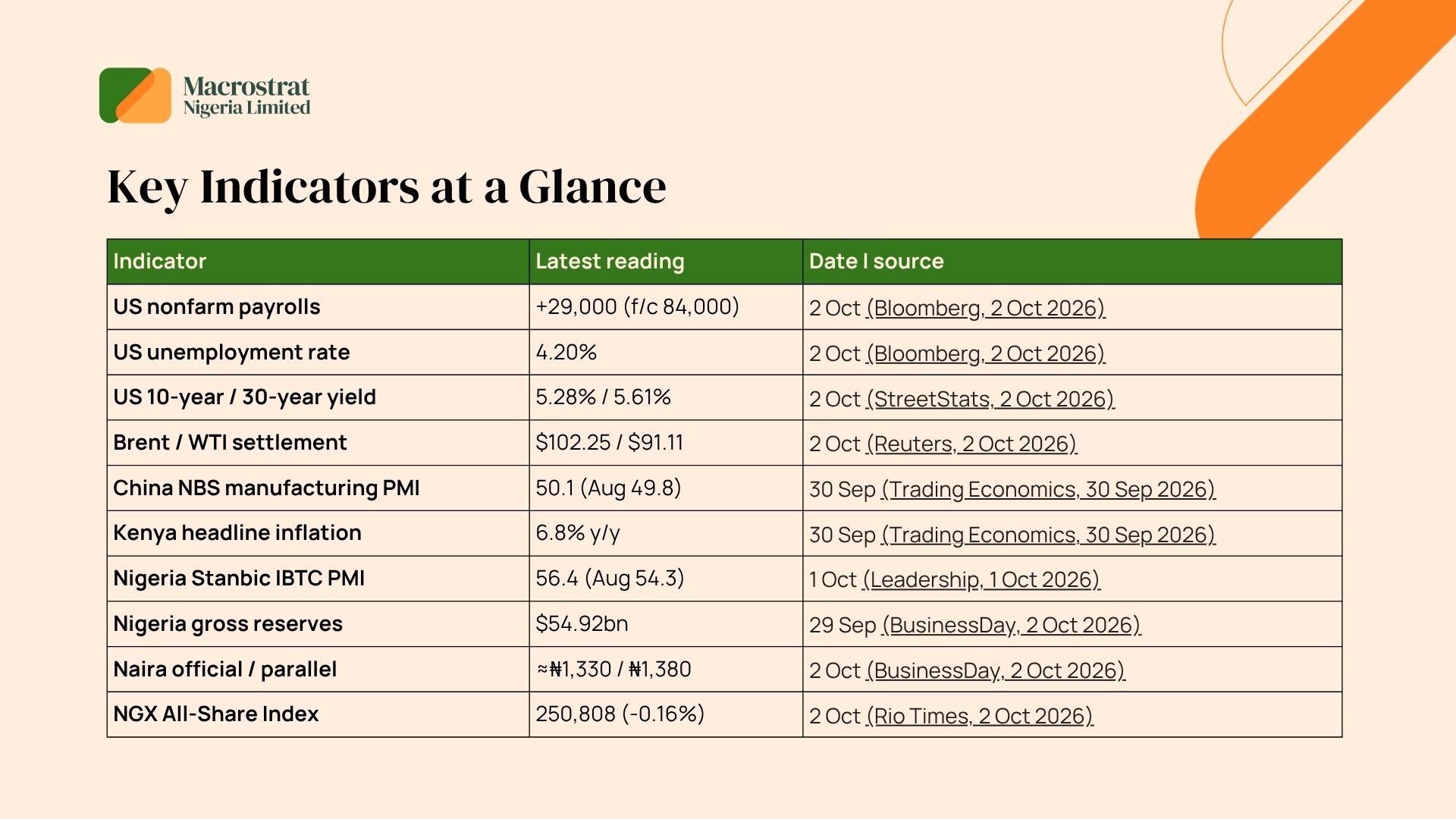
Global markets ended the week on a split-screen: equities rallied while sovereign yields stayed near multi-decade highs. A weak US jobs report on 2 October cut the market-implied chance of an October Fed hike to about 20%, lifting the Nasdaq to a record, yet the US 10-year yield closed near 5.28%. Brent settled at $102.25 after the G7 agreed on 2 October to release 100 million barrels of diesel and crude. In Nigeria, the September PMI jumped to 56.4, the highest since February 2022, while reserves reached $54.92bn and the naira held near ₦1,330/US$.
–
Introduction
This review covers data and events dated 28 September–4 October 2026 and previews scheduled events for 5–11 October 2026.
–
–
The World
Review. Payrolls rose only 29,000 in September against a forecast of 84,000, and unemployment edged up to 4.2%. Q2 US GDP was revised up to 2.2% and August real spending grew 0.6%, showing hard data still firm while surveys soften. The French–German bond spread widened to about 150bp and that rate risk is spilling into credit spreads. Oil settled at $102.25 (Brent) and $91.11 (WTI), with Brent roughly flat on the week. The G7 release runs over four months, with substantial diesel front-loaded within 20 days. China’s official manufacturing PMI returned to expansion at 50.1 on 30 September, with the composite at 50.7. The White House compact with major tech firms and the OpenAI IPO delay to next year, while Anthropic proceeds with its planned offering.
Monetary and yields. Fed-hike pricing swung from 70% to 20% for October over the week, while the December hike probability easing from 95% to 86%. The curve nonetheless stayed high: the 2-year yield was 4.84% and the 10-year touched 5.34%, its highest since 2002. This attributable less to the Fed than to structurally higher bond supply from governments and technology firms and weaker demand from long-term buyers.
Trade and energy policy. The G7 statement pledged to refrain from energy export restrictions after US pressure and a threatened US diesel export ban. China’s refiners suspended most fuel exports for October and Russia extended its diesel export ban. It is reported that Hormuz crude flows above 90% of pre-war levels but diesel at about 50%, explaining why diesel drove the policy response.
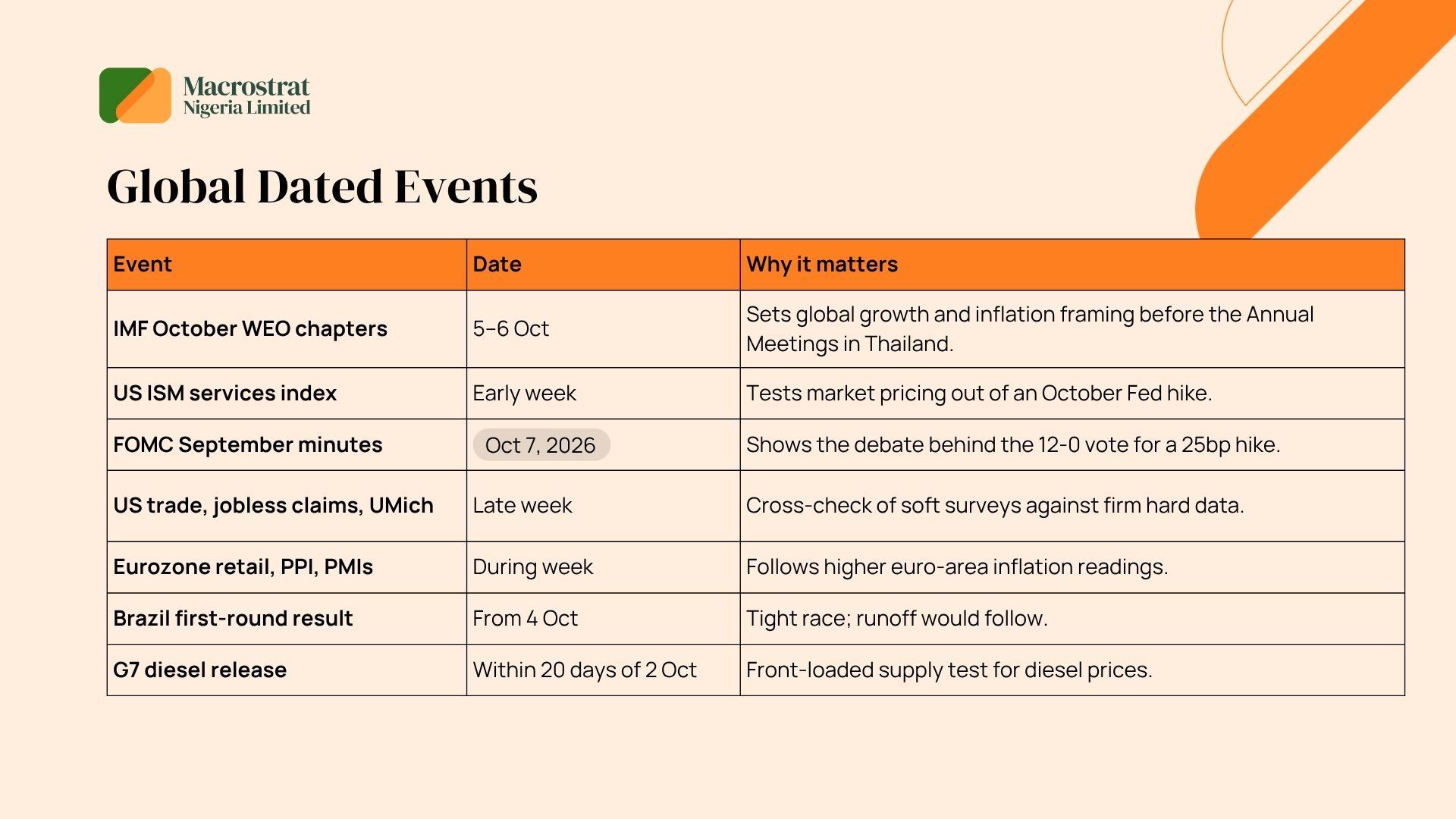
Outlook (5–11 Oct). Watch the US ISM services index early in the week, the IMF’s October World Economic Outlook chapters (5–6 Oct), and the FOMC minutes of the September meeting on 7 October. US CPI follows the week after, and the IMF/World Bank Annual Meetings in Thailand are next. Brazil’s tight first-round presidential vote was held on 4 October; results and a likely runoff are the key emerging-market event. Strong services data could test the market’s pricing out of an October hike. The calendar below summarises the dated events.
–
–
Africa
Review. Kenya’s inflation rose for a third month to 6.8% in September, the highest since January 2024 and above the 5% midpoint of the target range. Africa’s oil importers remain exposed to diesel and freight costs, which the G7 release aims to ease. Nigeria’s PMI stands out as the continent’s strongest high-frequency signal this week.
Growth and policy backdrop. The Central Bank of Kenya projected 4.9% growth for 2026 and warned that a prolonged Middle East conflict could raise inflation. The common regional theme is imported energy inflation constraining easing, even as oil exporters such as Nigeria benefit from higher crude prices and stronger external positions.
Outlook. The Central Bank of Kenya, which held its rate at 8.75% in August, said it would meet again in October; with inflation above midpoint, a hold is the base case, though the date was not confirmed in the sources reviewed.
–
Nigeria
Review. The naira was stable on 2 October at about ₦1,330 officially and ₦1,380 in the parallel market, a gap of roughly ₦50, while gross reserves rose to $54.92bn as of 29 September. The Stanbic IBTC PMI rose to 56.4 from 54.3, with new orders and output at their fastest since February 2022 but purchase prices at a three-month high on fuel, feed and food. Stanbic IBTC raised its 2026 growth forecast to 4.4%. Banks had not yet cut lending rates six days after the CBN’s 350bp cut to 23% on 22 September. The NGX All-Share Index fell 0.16% to 250,808 on 2 October, up 61.2% year-to-date, as eight public-sector unions prepared a three-day warning strike over fuel prices and wages.
BOP and growth. Reserves were 29.72% above their level a year earlier and covered 11.3 months of imports at end-August, supporting naira stability. Stanbic IBTC said the PMI is consistent with about 4.56% growth in Q3 2026. Unemployment, fiscal and trade-balance data were not released in the window; the latest official trade and inflation prints are background.
Outlook. Attention turns to how fast banks reprice credit to the 23% MPR, whether the strike disrupts services. Rising PMI input costs and fuel prices are the main risk to continued disinflation.
–
Conclusion
The week showed resilient growth signals against a stressed global bond market. Nigeria has strong external buffers and rising activity, but inflation pressure from fuel and a slow credit pass-through remain the swing factors.
–
Recommendations
Clients should (i) hedge dollar and rate exposure given near-5.3% US yields, (ii) lock in naira financing as lenders reprice to 23%, (iii) budget for diesel and feed cost volatility, and (iv) monitor the FOMC minutes, IMF outlook and September CPI before committing to large capital decisions.