Lower Inflation, Weaker Naira: The CBN’s Balancing Act
Executive Summary
Markets were driven by an AI-led equity rout and a hawkish Fed. On Friday 20 November the S&P 500 fell 3.70% and the Nasdaq 5.28%, the VIX closed at 38.40 and both the S&P 500 and Dow entered correction territory, even though Nvidia reported revenue up 103% on 17 November. The 10-year Treasury yield, at 4.92%, offered only a modest haven bid, and a 25bp Fed hike in December is almost fully priced. In Africa, South Africa held its repo rate at 7.25% with three of seven MPC members voting for a hike, while Ghana cut its policy rate 300bp to 11%. In Nigeria, October inflation eased to 14.06%, a six-year low, but the naira lost about 2.5% over the week to ₦1,394/$ and the equity market shed about ₦3.34trn. Next week, the CBN’s MPC (23–24 November), global flash PMIs (23 November), US PCE and revised Q3 GDP (25 November) and the Dangote Refinery IPO allotment are the key events.
–
Introduction
This note reviews 15–21 November and previews 22–28 November 2026 for the world, Africa and Nigeria.
–
** The World**
Review. Equities: the Dow lost more than 1% on every session of the week and the S&P 500 recorded its longest daily losing streak since February 2020. On 20 November the S&P 500 closed at 6,910.39 (−3.70%), the Dow at 48,147.33 (−1.93%) and the Nasdaq at 22,617.73 (−5.28%), erasing its 2026 gain; the VIX touched 40 before closing at 38.40. AI and chips: Nvidia’s third-quarter FY2027 revenue (17 November) was $115.8bn (+103% y/y), data-centre revenue $107.6bn, GAAP net income $65.3bn, and it guided to $130bn ±3% for Q4 excluding China data-centre compute. Yet the shares fell 14.01% on 20 November to $125.53, more than 10% below their post-earnings level, under interim CEO Colette Kress following Jensen Huang’s resignation on 12 November. Anthropic’s $81bn IPO (priced at $83, above the $70–78 indicated range) opened on 19 November at $111.50 but closed on 20 November at $88.91 (−8.5%); El-Erian argues that absorbing the issue forced portfolios to sell other holdings. Rates: the Fed released its October-meeting minutes on 18 November; the December debate has shifted from whether to hike to whether the move is 25bp or 50bp, with Governor Cook warning of falling “behind the curve”. US data stayed resilient, with a retail sales beat and low jobless claims. Commodities: WTI closed at $83.98 and Brent at $92.57 on 20 November, a third straight weekly fall; gold slid toward a 14-month low of $3,539 and copper fell almost 10% on the week. UK and Europe: UK October inflation and retail sales beat consensus, and the EU–UK reset summit on 20 November is estimated by the UK Treasury to lift GDP by 0.5 percentage points. China: October industrial output, retail sales and investment missed estimates (16 November), and the loan prime rates were left unchanged for an 18th month on 20 November.
Outlook. The week is holiday-shortened in the US (Thanksgiving, 26 November). Flash PMIs for November are due on Monday 23 November, with consensus for the eurozone composite at 51.6 (previous 51.7) and the UK composite at 53.1. US consumer confidence (24 November) precedes PCE inflation, personal income and spending, durable goods and the second estimate of Q3 GDP (initially 3.4% annualised) on Wednesday 25 November; core PCE is expected unchanged at 2.5%. The ECB publishes the account of its October meeting on 26 November, with a December hike widely expected, and eurozone economic confidence follows on 27 November. China’s October industrial profits are due on 26 November. Macrostrat view: the central question is whether forced selling and a December hike spill from asset prices into credit, investment and earnings, because the real economy still looks resilient.
–
Africa
Review. On 19 November the South African Reserve Bank held the repo rate at 7.25%, with three of seven MPC members favouring a 25bp hike; Governor Kganyago said inflation risks are skewed to the upside, with fuel inflation near 40% and petrol almost R30 a litre, and the Bank projects growth of about 2%. The next decision is on 28 January 2027. On 18 November the Bank of Ghana cut its policy rate 300bp to 11% from 14%, calling it a realignment to market rates, as October inflation rose for a third month to 5.5% and private-sector credit grew 37.2% y/y. Investment: South Africa’s Public Investment Corporation reportedly sought about $500m of Dangote Refinery shares, a sign of pan-African demand for Nigerian assets. Macrostrat view: the weaker copper, gold and oil prices recorded this week are a headwind for African commodity exporters and revenue.
Outlook. No other major African rate decisions are confirmed in our sources for 22–28 November. Macrostrat view: the main risks are a firmer dollar if US yields rise, further commodity weakness, and in Ghana the transmission of the new monetary framework to market rates, as inflation is now rising.
–
Nigeria
–
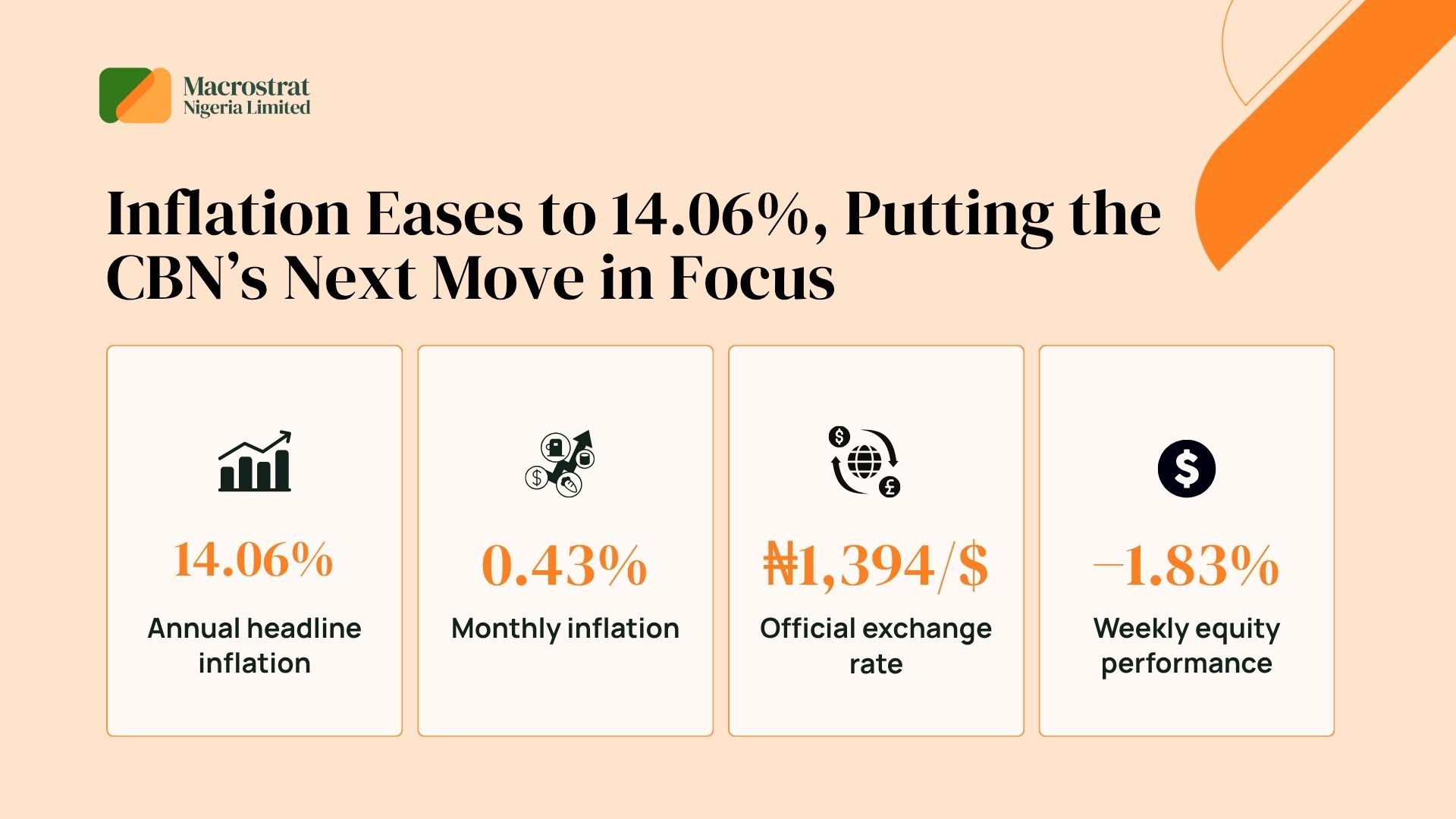
Review. Inflation: the NBS reported October headline inflation at 14.06% (September: 14.63%), the lowest since September 2020, with month-on-month inflation rising to 0.43% from 0.06%. Food inflation was 19.13% and core inflation 10.78% (from 12.95%). FX: the official NFEM rate weakened from ₦1,360/$ on 16 November to ₦1,394/$ on 20 November (−2.5% on the week, ₦1,400 intraday), the parallel market was near ₦1,458, and the CBN sold $1.30bn into rising demand; the one-year forward rate is ₦1,597.57. Gross reserves were $54.87bn on 12 November, down $390.94m over 16 days. Equities: the NGX All-Share Index closed at 247,660.74 on 20 November, down 1.83% on the week (+59.15% year to date), erasing about ₦3.34trn of market value; Dangote Cement fell 9.99% in one session to ₦1,323 and Aradel 10% to ₦1,166.40, with banks lower. Investment: the Dangote Refinery IPO drew applications worth about ₦5.85trn ($4.3bn), well above the $1.6–2.1bn on offer; the SEC postponed the allotment list so it can consider Aliko Dangote’s proposed secondary sale of part of his stake. No PMI, GDP or unemployment release fell in the window.
Outlook. The CBN MPC meets on Monday 23 and Tuesday 24 November, its last meeting of 2026. The MPR is 23%, the CRR 45% and the standing-facility corridor +50/−300bp; all five analysts surveyed by Nairametrics before the October CPI expected a hold, and after the print views ranged from a hold to a marginal cut, not another 350bp reset. Macrostrat view: with the naira under festive-season and pre-election pressure and US yields near 5%, a hold with a hawkish bias is the base case. Also in view: the Dangote allotment decision, the CBN’s FX supply after the $1.30bn sale, and any scheduling of the Q3 GDP release.
–
Conclusion The global backdrop turned from resilient growth to financial stress within a week, as strong AI earnings failed to offset supply of new equity, hawkish central banks and a commodity sell-off. Africa’s central banks are moving in opposite directions (South Africa tilting to hikes, Ghana cutting). Nigeria has lower inflation and large reserves, but a weakening naira, falling equities and a tight US rate environment reduce the room for easing.
–
Recommendations Policymakers: keep the CBN’s FX supply and reserve data transparent, treat the lower October CPI as a reason for caution rather than another large cut, and resolve the Dangote allotment quickly to protect market confidence.