Africa’s Largest Refinery Reshapes Nigeria’s Fuel Supply
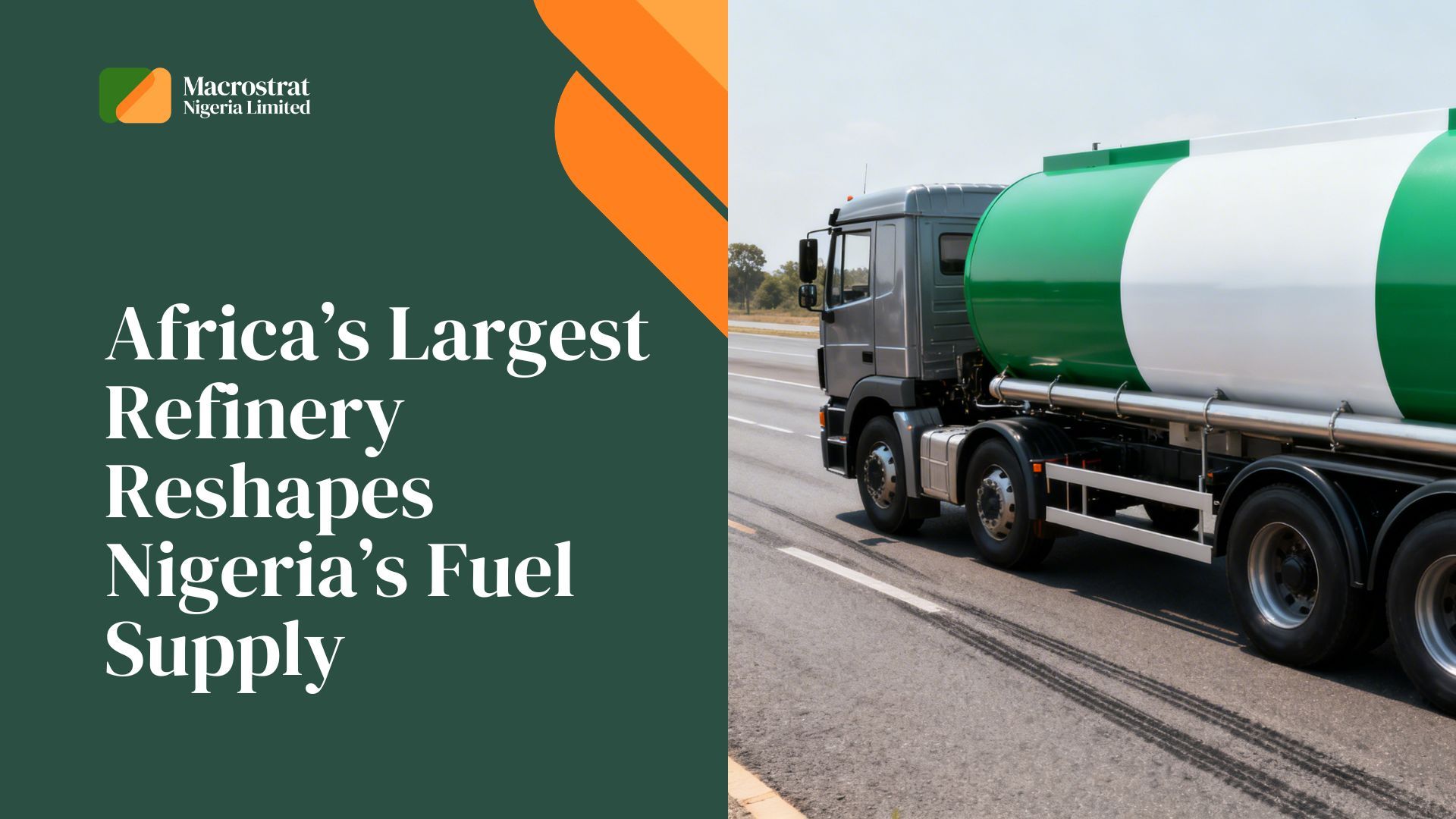
Nigeria’s downstream petroleum sector reached a significant turning point in February 2026 as domestic refining, driven largely by the Dangote Petroleum Refinery, supplied the overwhelming majority of petrol consumed in the country, pushing imports to their lowest level on record.
Data from the Nigerian Midstream and Downstream Petroleum Regulatory Authority (NMDPRA) show that total daily petrol supply declined from 64.9 million litres per day in January to 39.6 million litres per day in February, representing a 39.1% drop. The decline was driven almost entirely by a sharp reduction in imported fuel as domestic refineries increased output.
Local refineries supplied an estimated 36.5 million litres per day during the month, accounting for roughly 92% of total petrol supply. In contrast, imported volumes fell to about 3.1 million litres per day—around 8% of supply—marking the lowest level since the regulator began publishing detailed supply data.
The shift reflects the rapid scaling of domestic refining capacity, led by the Dangote refinery, which has been ramping up production since it began refining operations in 2024.
Despite the sharp drop in imports and total supply volumes, the market remained adequately supplied. Nigeria maintained roughly 31 days of petrol sufficiency in February, while average daily consumption was estimated at about 36.6 million litres—nearly matching the volume supplied by domestic refineries.
The alignment between local production and national consumption suggests that Nigeria is approaching a point where domestic refining can largely meet internal demand without relying heavily on imported fuel.
The Dangote refinery has been central to this shift. With a nameplate capacity of around 650,000 barrels per day, the facility is the largest refinery in Africa and the world’s largest single-train refinery. At full capacity it can produce more than 100 million litres of refined petroleum products daily, including as much as 57 million litres of petrol, alongside diesel and aviation fuel.
As production continues to ramp up, the refinery is expected to supply the majority of Nigeria’s petrol needs and could eventually generate surplus volumes for export across West and Central Africa.
For decades, Nigeria paradoxically exported crude oil while importing most of its refined petroleum products due to insufficient domestic refining capacity. At various points, imports accounted for the majority of petrol consumed in the country, exposing the economy to foreign exchange pressures and global price volatility.
The February 2026 data suggest that the expansion of domestic refining capacity is beginning to reverse that pattern. If current trends continue and additional local refineries increase output, Nigeria could gradually transition from one of the world’s largest gasoline importers to a regional supplier of refined fuels.